





An industrial sheet metal polishing machine is often evaluated by how effectively it removes burrs or improves the metal surface.
But for manufacturers processing precision sheet metal, there is another important concern: how can finishing be completed without creating unnecessary changes to the workpiece itself?
Thin plates, precision chassis components, medical-device sheet metal, and other accurately manufactured parts may require careful finishing. Excessive grinding force, unsuitable processing parameters, or inconsistent edge treatment can make the finishing stage more difficult to control.
The SPR-13000BBR Flat Grinding, Deburring & Polishing Machine is designed for precision sheet metal, ultra-thin plates, and finely machined workpieces.
Its adjustable grinding force, variable processing parameters, flexible grinding structure, and controllable edge-rounding functions provide manufacturers with several ways to manage delicate finishing applications.
This article looks at three important areas: protecting plate flatness, controlling grinding conditions, and managing precision edge finishing.
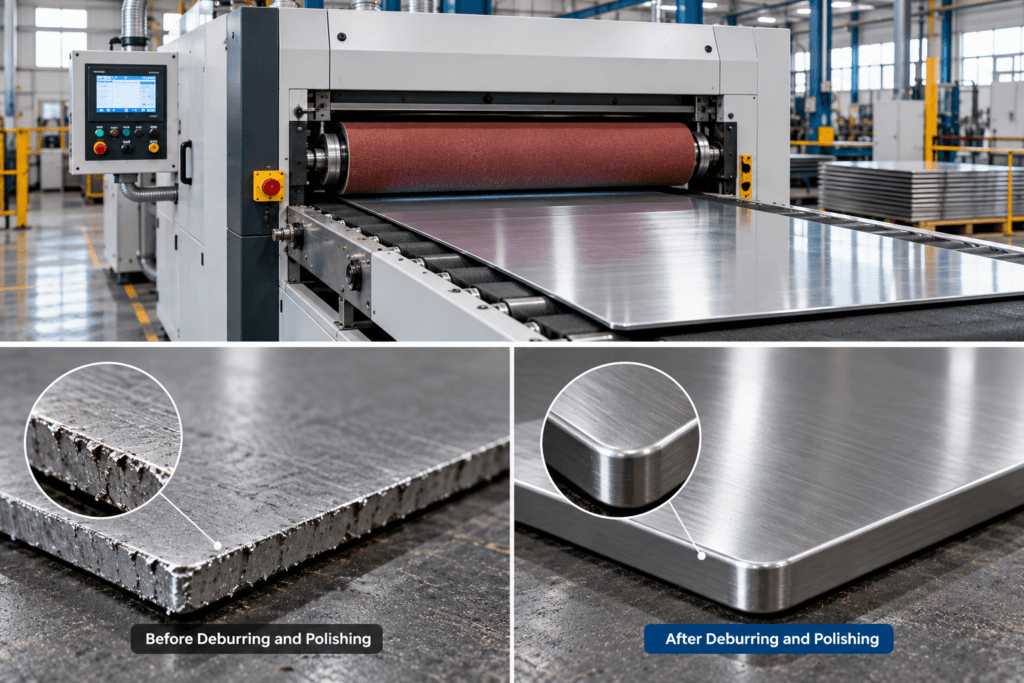
1. Industrial Sheet Metal Polishing Machine for Protecting Plate Flatness
For precision sheet metal, removing burrs is only part of the job.
The condition of the original plate also needs to be considered.
When manufacturers are working with thin or accurately processed metal parts, aggressive finishing may not always be appropriate.
The SPR-13000BBR uses a variable-frequency drive system with controllable grinding force.
According to the product information, this processing design helps protect the base material and maintain the flatness of the plate.
This is particularly relevant for parts where the finished surface must be improved without unnecessarily affecting the original workpiece.
Why Plate Flatness Matters
Imagine a workpiece that has already completed cutting and dimensional processing.
If too much material is removed during the finishing stage, additional correction may be required later.
A suitable industrial sheet metal polishing machine therefore needs more than strong grinding capability.
It also needs control.
The operator should be able to adjust the process according to the actual condition of the part rather than applying the same grinding force to every workpiece.
The SPR-13000BBR provides this type of adjustment through controllable grinding force and variable processing settings.
For manufacturers handling precision sheet metal, this makes it possible to focus on the required finishing result while reducing unnecessary processing of the base material.
2. Industrial Sheet Metal Polishing Machine with Adjustable Processing Control
Different parts do not always respond to the same finishing conditions.
One workpiece may be relatively thin.
Another may be much thicker.
Some parts may have only small edge burrs, while others may require more intensive deburring after laser cutting.
Using one fixed setting for all of these situations can make production difficult to control.
The SPR-13000BBR has a stated processing thickness range of 0.8–80 mm.
Its workbench width is 1000 mm, and the minimum listed non-perforated workpiece size is 50 × 50 × 0.8 mm.
The machine also provides:
- 0.5–6 m/min adjustable delivery speed
- 0–1450 r/min sanding-belt speed
- 0–18 r/min rubber roller speed
These adjustable parameters allow operators to change the processing conditions when workpiece requirements change.
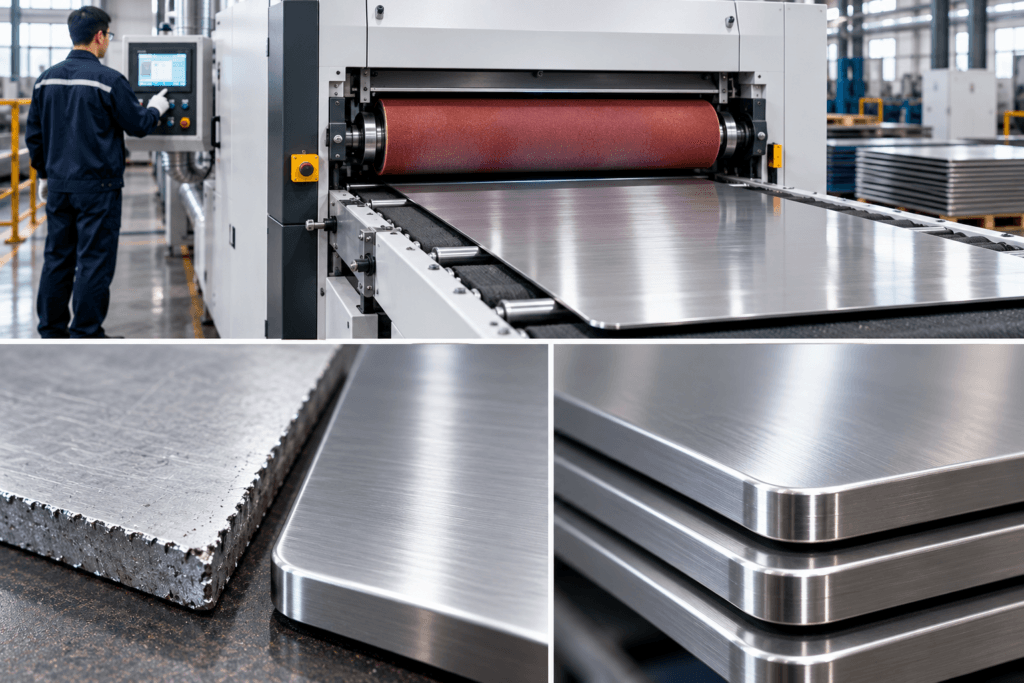
Better Control for Different Production Jobs
An industrial sheet metal polishing machine does not necessarily need to process every component in exactly the same way.
A more practical approach is to select settings according to the actual job.
For example, changing the delivery speed changes how quickly the workpiece moves through the machine.
Adjustable sanding-belt speed provides another processing variable.
Controllable grinding force gives the operator additional control over how aggressively the surface is processed.
Together, these functions create more flexibility when manufacturers need to handle different workpiece specifications.
This can be especially useful for factories that manufacture multiple types of precision sheet metal products rather than running only one standard part.
3. Industrial Sheet Metal Polishing Machine for Precision Edge Rounding
Surface finishing is not the only requirement for many precision components.
Edges can also require additional processing.
Laser-cut parts may contain hard slag, micro-edge burrs, or sharp edges.
If these remain on the finished component, another deburring or edge-processing step may be required.
The SPR-13000BBR combines wide abrasive belts with flexible grinding components.
The machine is designed to remove laser-cut hard slag and micro-edge burrs while also providing controllable edge rounding.
It supports adjustable R-angle processing, allowing manufacturers to manage the edge-finishing process according to their requirements.
Burr Removal and Edge Rounding Are Different Tasks
Removing a burr and creating a controlled rounded edge are related, but they are not exactly the same process.
A burr may simply need to be removed.
Another component may require a more defined edge condition.
For this reason, an industrial sheet metal polishing machine that provides adjustable edge processing gives manufacturers greater flexibility than a machine focused only on surface polishing.
The SPR-13000BBR is listed for applications including:
- Precision components
- Precision chassis
- Medical-device sheet metal
- New-energy metal parts
These types of applications can require attention to both surface condition and edge quality.
A controlled edge-finishing process can therefore become an important part of the overall production workflow.
SPR-13000BBR Technical Parameters
| Parameter | Specification |
|---|---|
| Workbench Width | 1000 mm |
| Processing Thickness | 0.8–80 mm |
| Minimum Non-Perforated Workpiece | ≥ 50 × 50 × 0.8 mm |
| Delivery Speed | 0.5–6 m/min, Variable Frequency Adjustable |
| Sand Belt Speed | 0–1450 r/min |
| Rubber Roller Speed | 0–18 r/min |
| Maximum Power | 59 kW Without Dust Collector |
| Rated Voltage | AC 380V / 3P / 50Hz |
| Air Pressure | 0.6–0.8 MPa |
| Weight | Approximately 5800 kg |
How to Evaluate an Industrial Sheet Metal Polishing Machine for Precision Parts
Before selecting an industrial sheet metal polishing machine, manufacturers should first define what needs to be protected and what needs to be changed.
These questions help manufacturers compare a real production requirement with the machine’s capabilities.
A machine with strong grinding power may not automatically be the most suitable option for every precision application.
For delicate parts, controllability can be just as important.
The SPR-13000BBR combines adjustable delivery speed, adjustable sanding-belt speed, controllable grinding force, burr removal, and adjustable edge rounding.
These functions allow manufacturers to approach finishing as a controlled process rather than simply a material-removal step.
For complete machine information, visit the SPR-13000BBR Flat Grinding, Deburring & Polishing Machine.
Manufacturers working with stainless steel can also refer to World Stainless for additional general information about stainless steel materials and applications.
Repeatability Also Matters for Precision Production
Once suitable processing parameters have been established, maintaining them across future production batches can become another challenge.
The SPR-13000BBR supports parameter memory and one-touch process recall.
This allows previously established processing settings to be stored and reused when similar workpieces return to production.
For precision manufacturing, this can help reduce the need to rebuild the same machine settings every time a repeat order arrives.
It also supports a more standardized production workflow.
The machine is designed for continuous 24/7 mass production, and its body receives anti-rust and anti-corrosion treatment.
For manufacturers with repeated production requirements, this combination of adjustability and parameter storage can make the finishing stage easier to organize.
Conclusion
When manufacturers evaluate an industrial sheet metal polishing machine, the question should not only be how much material the machine can remove.
For precision components, the more important issue may be how carefully the finishing process can be controlled.
The SPR-13000BBR addresses this requirement in three main ways.
First, controllable grinding force helps manufacturers process parts while protecting the base material and plate flatness.
Second, adjustable delivery speed, sanding-belt speed, and processing parameters allow the machine to adapt to different workpiece requirements.
Third, its flexible grinding structure and adjustable R-angle processing provide greater control over burr removal and edge finishing.
For manufacturers working with precision sheet metal, these capabilities can help create a finishing process that focuses not only on removing defects, but also on preserving the condition of the original workpiece.