





For manufacturers running repeated sheet metal production, choosing Industrial Polishing Machines is not only about the final surface appearance.
A machine may produce an acceptable result on one workpiece, but industrial production creates a different challenge: the same finishing process may need to run repeatedly across multiple batches while operators manage different production schedules.
Frequent parameter adjustments, unstable processing conditions, and equipment interruptions can make metal finishing more difficult to manage.
The SPR-13000BBR is designed for grinding, deburring, edge rounding, and polishing of precision metal components. Its PLC control system, variable-frequency adjustment, stored processing parameters, and industrial machine structure are intended to support a more controlled production process.
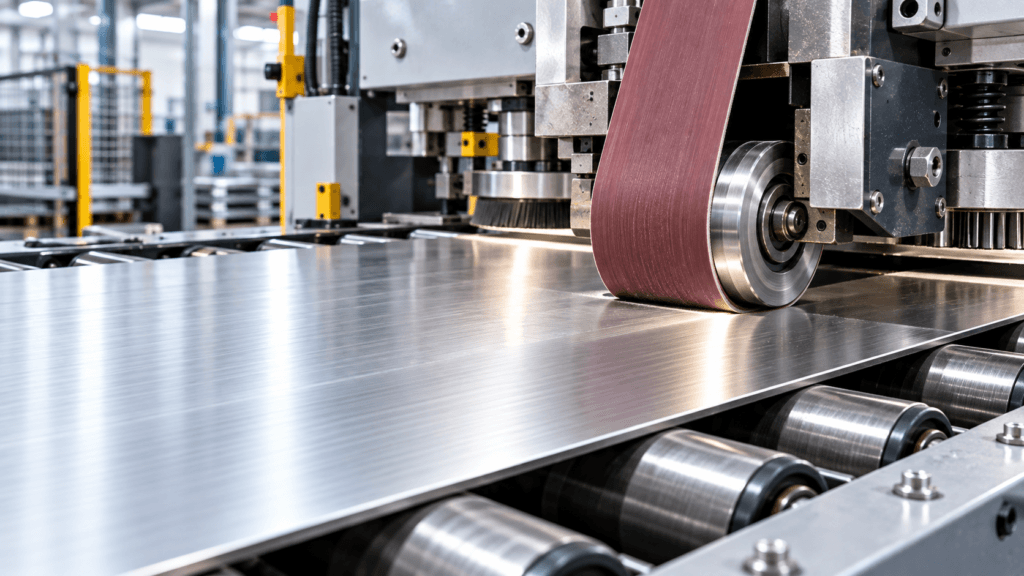
1. Industrial Polishing Machines Need Repeatable Process Settings
One common production problem appears when the same component returns for another batch.
If operators have to rebuild processing settings every time, the finishing process becomes more dependent on manual setup.
The SPR-13000BBR includes parameter memory and one-touch process recall.
Previously stored processing parameters can be recalled when similar workpieces return to production.
For manufacturers using Industrial Polishing Machines, this can make repeated jobs easier to organize.
Instead of starting from zero every time, operators can return to previously used processing conditions and make adjustments according to the current workpiece requirements.
Why This Matters for Repeated Orders
Many manufacturers do not process only one type of part.
A factory may finish one product today and return to the same product several days or weeks later.
Parameter memory provides a more structured way to manage these repeated production requirements.
It does not remove the need for operator judgment, but it can reduce unnecessary repeated setup work.
2. Continuous Production Requires Industrial Machine Design
Another challenge is machine availability.
When a finishing machine is used as part of a production line, unexpected downtime can affect more than one processing stage.
The SPR-13000BBR uses an anti-rust and anti-corrosion treated machine body and is designed for continuous industrial production.
The product information also states that the electrical components use internationally sourced brands.
For Industrial Polishing Machines, these design considerations are especially relevant when the equipment needs to support repeated production rather than occasional finishing work.
Industrial Processing Specifications
The SPR-13000BBR includes:
- Workbench width: 1000 mm
- Processing thickness: 0.8–80 mm
- Delivery speed: 0.5–6 m/min
- Sand belt speed: 0–1450 r/min
- Rubber roller speed: 0–18 r/min
- Maximum power: 59 kW without dust collector
- Rated voltage: AC 380V / 3P / 50Hz
- Air pressure: 0.6–0.8 MPa
- Approximate weight: 5800 kg
These specifications help manufacturers determine whether the machine matches the production environment and workpiece range.
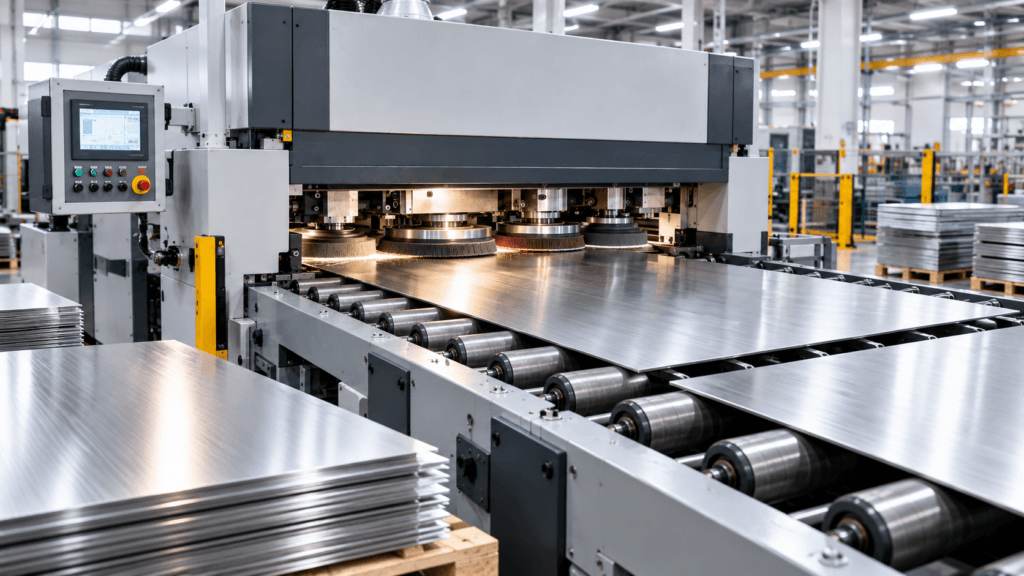
3. Better Process Control Can Simplify Production Management
Industrial finishing often involves more than turning a machine on and off.
Operators may need to adjust grinding force, conveyor speed, abrasive belt speed, and other processing conditions according to the workpiece.
The SPR-13000BBR uses PLC control and variable-frequency adjustment to give operators control over the finishing process.
Its controllable grinding force is designed to protect the base material while maintaining plate flatness.
For factories evaluating Industrial Polishing Machines, this level of process control is important because different workpieces may require different finishing conditions.
A more controlled process also gives manufacturers a clearer way to manage production settings across multiple jobs.
Choosing Industrial Polishing Machines for Continuous Production
When comparing Industrial Polishing Machines, manufacturers should consider more than the polishing result of a single sample.
It is also important to evaluate:
- How often the machine will run
- How many different workpieces will be processed
- Whether repeat jobs are common
- How often parameters need to be changed
- Required plate thickness range
- Workpiece dimensions
- Edge-finishing requirements
- Production volume
The SPR-13000BBR combines parameter memory, PLC control, variable-frequency adjustment, controllable grinding force, and an industrial machine structure.
For manufacturers managing repeated sheet metal finishing jobs, these features can help create a more organized and repeatable production process.
If you are selecting Industrial Polishing Machines, provide the actual workpiece material, dimensions, thickness, burr condition, and required finishing result before confirming the machine configuration.