





Polishing Machines play an important role in precision sheet metal production, especially when manufacturers need to remove laser-cut slag, micro burrs, and sharp edges while maintaining a consistent surface finish.
For manufacturers working with thin plates, laser-cut components, precision sheet metal parts, and finely machined workpieces, the challenge is not simply making the metal surface look smoother. The finishing process must remove unwanted burrs without unnecessarily damaging the base material or affecting plate flatness.
At the same time, manufacturers handling repeated production batches need stable and repeatable finishing results.
The SPR-13000BBR is designed for applications involving deburring, grinding, edge rounding, and polishing. Its abrasive belt system, flexible grinding components, adjustable processing parameters, and PLC-based control help manufacturers create a more controlled metal-finishing process.
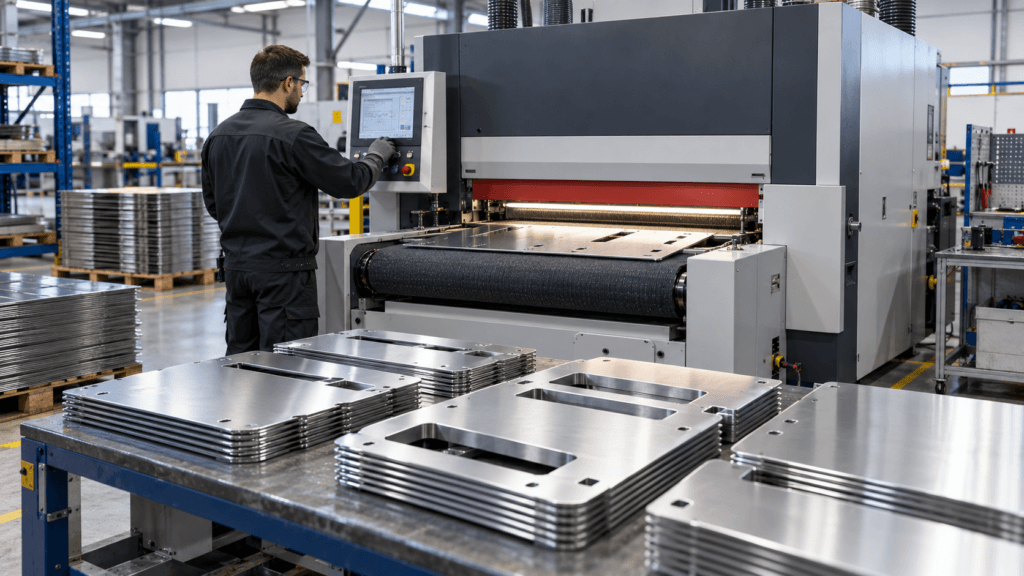
1. Polishing Machines Help Remove Hard Slag and Micro Burrs
One of the most common problems after laser cutting is the presence of hard slag and small burrs around the edges of metal components.
These defects normally need to be removed before the workpiece moves to the next stage of production.
However, aggressive grinding can introduce another problem. Excessive grinding pressure may remove more material than necessary or affect the original condition of the metal plate.
This is especially important when processing precision sheet metal, thin plates, chassis components, medical-device sheet metal, and new-energy metal parts.
The SPR-13000BBR uses a variable-frequency drive system with controllable grinding force. This allows operators to adjust the processing conditions according to different workpiece requirements.
The machine combines wide, wear-resistant abrasive belts with flexible grinding components. These components are designed to remove laser-cut hard slag and micro-edge burrs while supporting controlled edge finishing.
For manufacturers evaluating Polishing Machines, this balance between burr removal and workpiece protection is important.
The goal is not simply to grind the metal harder. A more controlled process helps remove unwanted material while reducing unnecessary impact on the workpiece.
Why Controlled Grinding Matters
A finished component may still need to go through welding, coating, assembly, or other manufacturing processes.
For this reason, manufacturers need to consider both burr removal and the condition of the finished surface.
A controlled Polishing Machines process can help manufacturers achieve a more consistent result while maintaining the original characteristics of the workpiece.
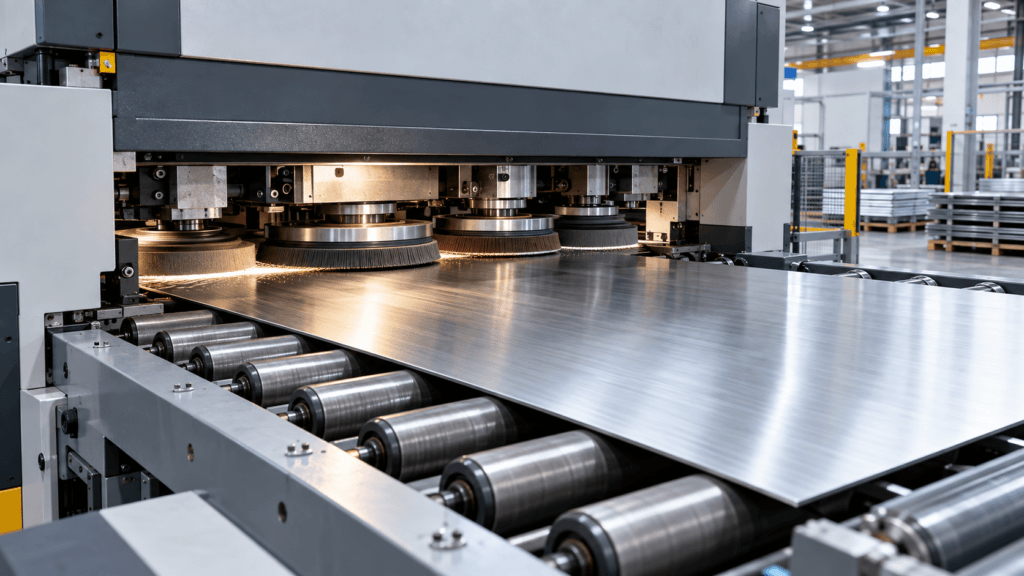
2. Polishing Machines Improve Edge Rounding Consistency
Another important challenge in sheet metal finishing is repeatability.
A workpiece may look acceptable after one production run, but manufacturers producing the same component repeatedly need similar finishing results across different batches.
The SPR-13000BBR supports adjustable R-angle processing.
This allows manufacturers to control edge-rounding requirements according to the workpiece and production needs.
The machine also includes parameter memory and one-touch process recall.
When the same type of workpiece needs to be processed again, stored parameters can be recalled instead of rebuilding the entire processing setup from the beginning.
This makes Polishing Machines particularly useful for manufacturers that regularly process repeated batches of similar sheet metal components.
Processing Range
According to the machine specifications, the SPR-13000BBR includes:
- Workbench width: 1000 mm
- Processing thickness: 0.8–80 mm
- Minimum non-perforated workpiece: ≥50 × 50 × 0.8 mm
- Delivery speed: 0.5–6 m/min
- Sand belt speed: 0–1450 r/min
- Rubber roller speed: 0–18 r/min
- Maximum power: 59 kW without dust collector
- Rated voltage: AC 380V / 3P / 50Hz
- Air pressure: 0.6–0.8 MPa
- Machine weight: approximately 5800 kg
Adjustable processing parameters allow manufacturers to adapt the machine to different production requirements.
For companies producing precision components, consistent processing conditions can be just as important as the initial finishing quality.
3. Polishing Machines Support More Efficient Batch Production
Industrial metal finishing is not only about surface quality.
Manufacturers also need equipment that can operate reliably during repeated or continuous production.
The SPR-13000BBR uses an anti-rust and anti-corrosion treated machine body and is designed for continuous industrial production.
The machine also uses a PLC control system, allowing operators to manage processing parameters through a centralized control interface.
When combined with variable-frequency adjustment and parameter memory, this creates a more organized production process for deburring, grinding, edge rounding, and polishing.
For manufacturers handling multiple batches, Polishing Machines with stored processing parameters can reduce the need to repeatedly recreate previous settings.
Suitable Metal Finishing Applications
The machine is designed for applications such as:
- Precision sheet metal
- Thin metal plates
- Laser-cut components
- Precision chassis parts
- Medical-device sheet metal
- New-energy metal components
These applications often require more than simple burr removal.
Manufacturers may also need controlled edge rounding, improved surface condition, and consistent processing between different production batches.
Choosing the Right Polishing Machines for Your Production
Choosing the right Polishing Machines should begin with the actual workpiece rather than only comparing machine specifications.
Manufacturers should consider factors such as:
- Workpiece material
- Plate thickness
- Part dimensions
- Burr condition
- Laser-cut slag
- Required edge radius
- Desired surface finish
- Production volume
The SPR-13000BBR combines abrasive belt grinding, flexible grinding components, adjustable R-angle processing, variable-frequency control, and processing-parameter memory.
These features are designed to address one of the main challenges in precision sheet metal finishing: removing unwanted burrs and slag while maintaining controlled and repeatable processing conditions.
For manufacturers processing precision sheet metal parts, a properly configured polishing and deburring process can help improve edge quality and make repeated production more consistent.
You can explore our Flat Grinding, Deburring & Polishing Machines to compare machine features and processing capabilities.